Scaffolding
The banging has finally stopped, and the workers have finished nailing sheets of tin around the eaves of our house. The space under the roof had been open, and a community of pigeons had made their homes in our landlord’s attic. Now the birds have been evicted, and it is usable storage space.
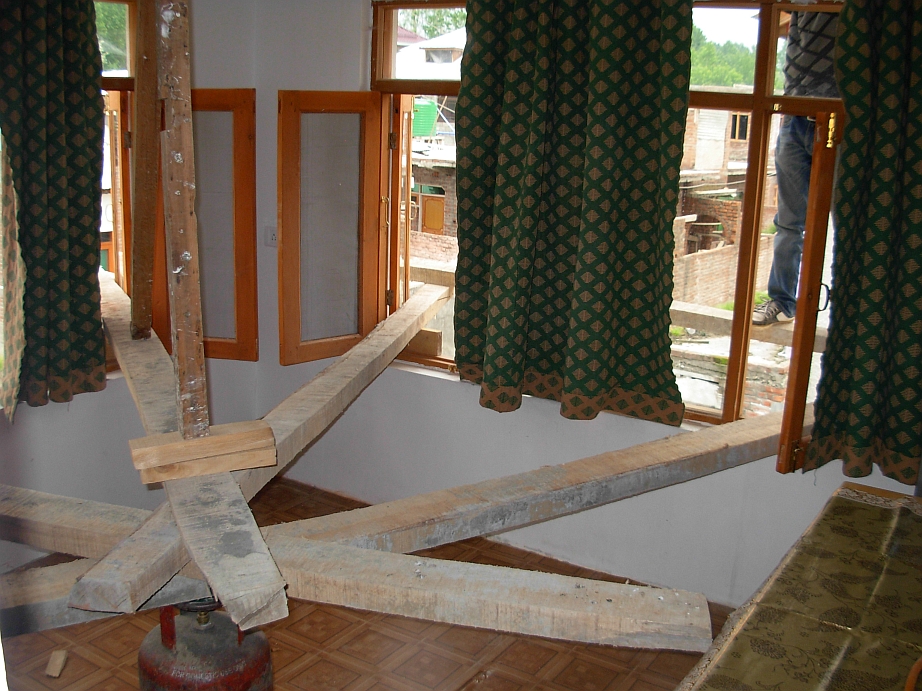
Outside the right window, can you see the legs of the worker?
Instead of using ladders on the outside of the house, the workers erected a type of scaffolding we had never seen before. In each room of our upstairs apartment, they placed thick beams sticking out the windows and stacked them together in the center of the room, bracing them from floor to ceiling. They then added beams on the outside, across the ends, providing a place to stand for work at roof level. Watching this being set up, it looked crazy, but it’s normal construction practice here. In fact, the whole process was relatively efficient, and the work was done with no injuries!
As I watched these guys climbing out on the beams, that familiar feeling surfaced again in my heart—it’s risky. In the last few weeks I’ve faced some new challenges that feel something like climbing out a window on a wobbly piece of wood with a long drop beneath me. Is my scaffolding put together right? Did I use sturdy wood? Did I brace it strongly enough in the center? I’m deeply grateful for the thoughts and prayers of my family and friends; they make up the spiritual and emotional scaffolding under my feet.
Posted in Uncategorized by Lisa
Water from the Source
I enjoyed an experience of beauty today, exploring one of the Mughal gardens that our area is famous for. Walking through the gate is like passing into a parallel dimension—from the dirty, crowded street full of noisy Indian traffic, we suddenly found ourselves in a cool, leafy space with the sounds of bird calls and waterfalls around us. The Mughal emperors built these gardens in the 17th Century and planned them so that one would never be out of earshot of falling water. 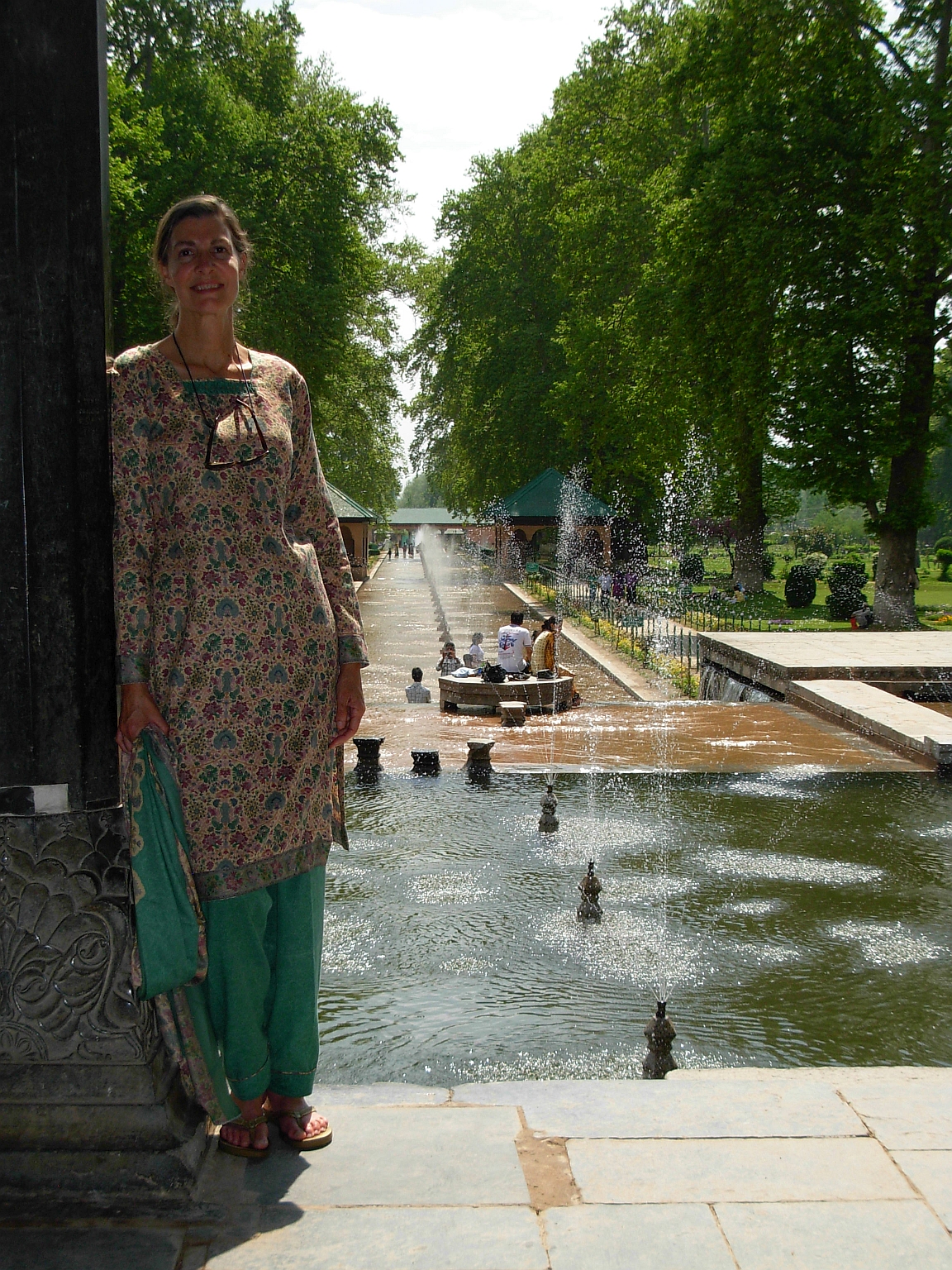 Pavilions with carved marble pillars stand like islands surrounded by pools and fountains. Even in the heat of mid-summer, these gardens are an invitation to rest and peace.
Just as lovely as the gardens, to me, were the people I saw enjoying them. The Mughal gardens are a tourist destination for Indians, especially for honeymooners, and we saw young couples posing among the flowers for Bollywood-style photos. There were families gathered for picnics in the shade. And the shallow pools and gentle fountains seemed designed with children in mind—their laughter as they waded and splashed harmonized with the sound of the falling water.
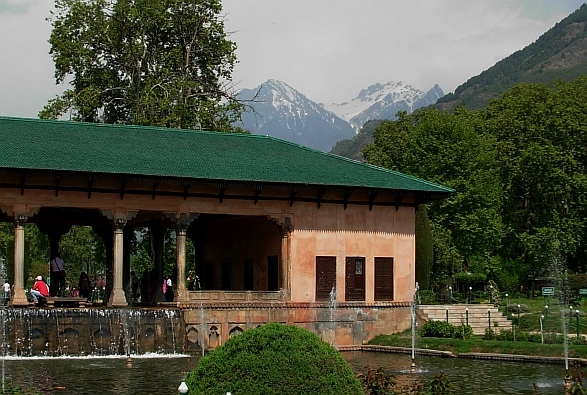 From the garden entrance, I looked up and noticed the mountains in the distance, still holding the winter’s supply of snow. The glacier visible thousands of feet higher up is the source of the water that keeps these fountains splashing. It’s that uninterrupted connection to the source that nourishes the garden’s life, beauty, and peace.
Posted in Uncategorized and tagged Garden by Lisa
Finger Food
Since our arrival six weeks ago, we’ve been enjoying meals prepared by our landlord’s wife. (We don’t quite have our kitchen set up yet, and even if we did, we’re too busy with language lessons to do much shopping or cooking.) Lunches and dinners are generally rice with dal (lentil or bean sauce) and cooked vegetables. We’re grateful that she has diminished the quantity of chili she uses, in order to accommodate our wimpy palates!
Our landlord explained to us early on that they normally eat with their right hands, but that they would provide spoons for us. For the first month or so we used the spoons, but then decided to make the switch to “manual” eating. Eating with our hands is certainly not a new experience for us, as this was normal where we used to live, in West Africa. But we didn’t want to assume that the same technique was used here, so we got some coaching from our landlord’s family. 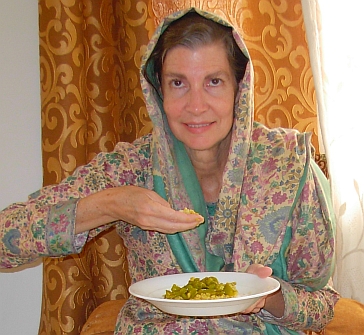 We’ve been practicing at each meal, scooping food up with our fingers together, and slurping it into our mouths, with less and less mess. Another important question: At the end of the meal, am I being impolite if I lick my fingers? Answer: No, in fact, licking off my fingers will signal that I really appreciated the meal!
Our landlord’s wife beamed with delight the first time we told her we didn’t need spoons. They say here that food tastes better when eaten with the hands, so she probably thought we hadn’t truly been appreciating her food! Now we get the full sensory experience! Afterwards, despite licking my fingers and then washing my hands with soap, I noticed that my fingernails retained the turmeric-yellow color of the dal. After lunch yesterday we were walking on the main street of our “village” and met our friend Shahaz’s husband in front of his shop. He greeted us warmly and reached out his hand to shake Brad’s. I noticed that his fingers were also yellow, and I laughed and showed him mine. He smiled and said, “It looks like we both had a good lunch!” Dal-stained fingernails… one small way of getting closer to our food, and to the people and culture it represents.
Posted in Uncategorized and tagged Manual Eating by Lisa
My First Friend
I’ve made my first real friend! Her name is Shahaz. Her husband owns the shop near our house on the main street, across from where we wait for the bus most mornings. Brad has chatted with him several times, and he invited us to come over for tea, so we did. Their shop is small and somewhat shabby-looking, but their house, behind it, is surprisingly large and well-furnished, with a lovely garden. Shahaz seemed delighted to see us and gave us a warm welcome. She made us comfortable with cushions on the rug and sent her daughter-in-law to the kitchen to make chai (tea).
When the chai arrived, it was accompanied by 6 plates of sweets and snacks—I have a few things to learn about hospitality! Shahaz speaks some English, and she was as curious about my family as I was about hers. She has four grown children, two of whom are married with kids, and they all live nearby. She has a daughter who teaches elementary school, and she was thrilled to find that I do also—something we have in common. I had worn my new Easter outfit, which has a long matching headscarf. Shahaz admired my outfit, but I confessed that I didn’t know how to manage the scarf. 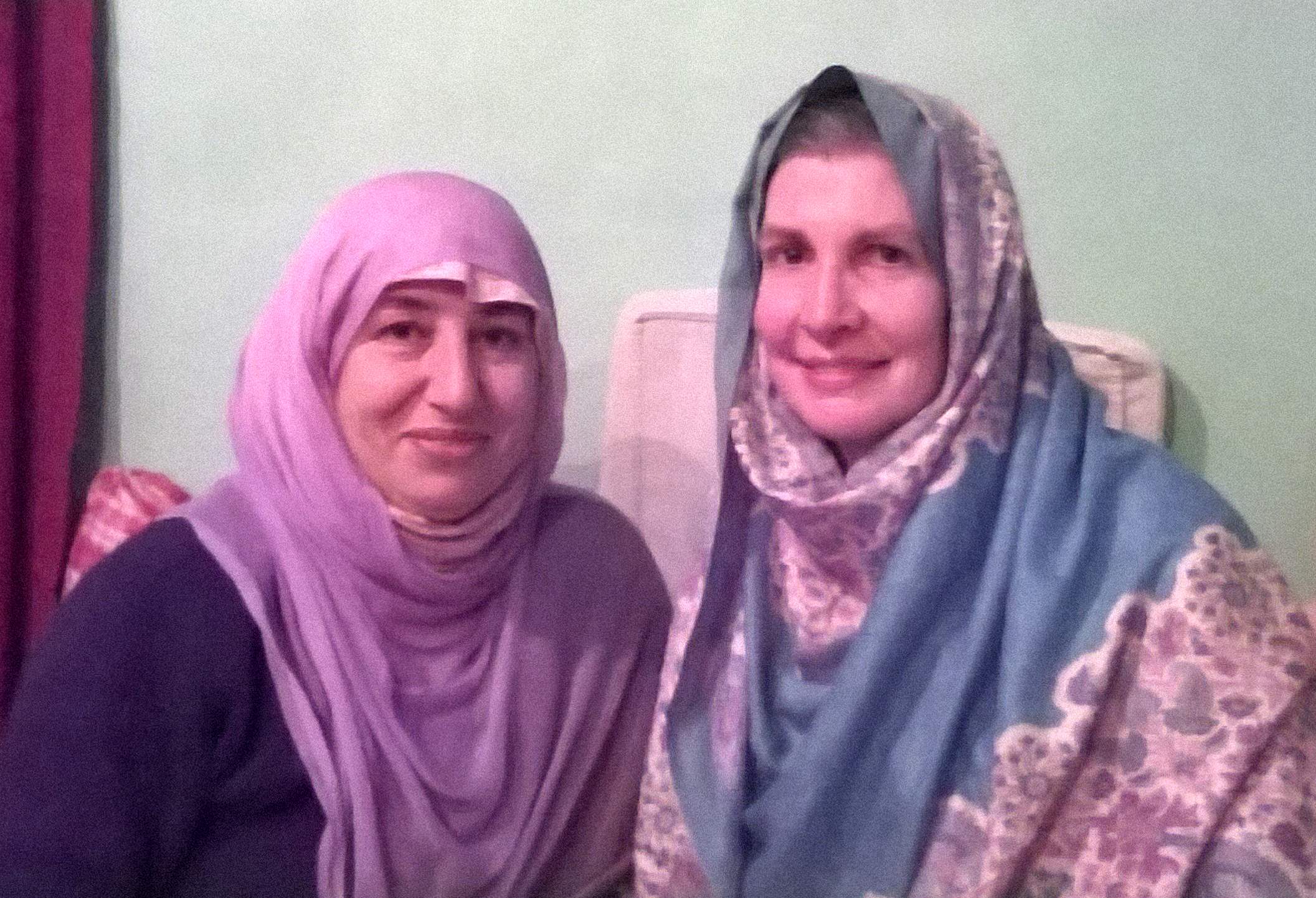 I took it off, moved closer to her, and asked her to wrap it for me like she had hers. She did, and her hands felt gentle around my head as her fingers smoothed my hair back under the scarf. With three daughters looking on in amusement, we all started laughing! She finished off by planting a kiss on my forehead, and then we all got our phones out and took photos together!
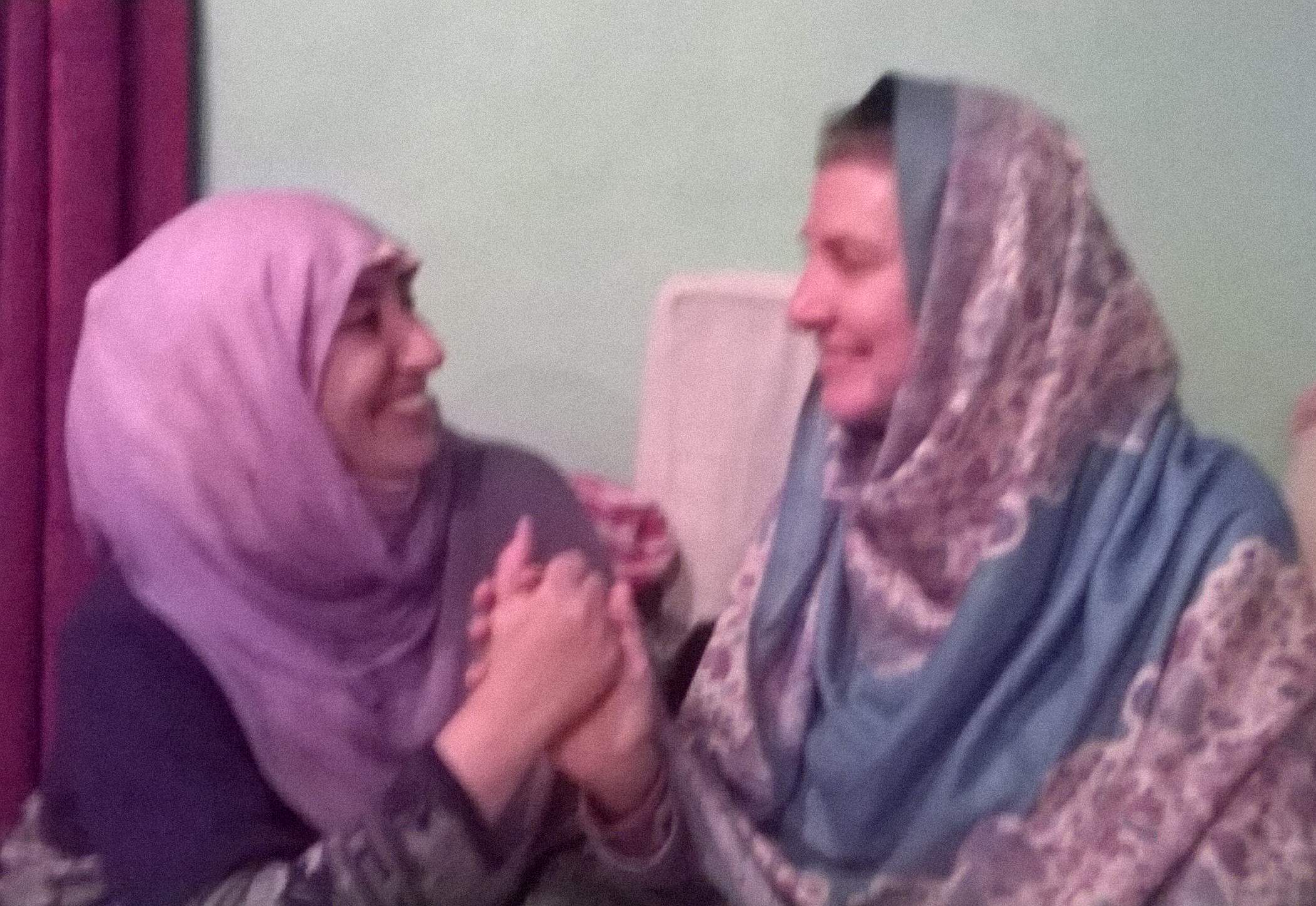 As we said good-bye, Shahaz took my hand tightly and taught me the local word for “friend.” She made me repeat it back several times, and told me to come again soon. One of the principles of language learning is that we remember best the words and expressions that we learn in the context of memorable experiences. Thanks to Shahaz, “friend” is a word that I won’t forget.
Posted in Uncategorized and tagged friend by Lisa
Toilet Talk
One of the many things we’ve been learning about recently: bathrooms. A recent language lesson featured kitchen and bathroom nouns. It turned out to be harder than we thought to nail down the local word for “toilet” because it’s considered a shameful thing to talk about. Our language helper offered “WC” and “latrine,” but couldn’t come up with a native language word because it would be something they would never say!
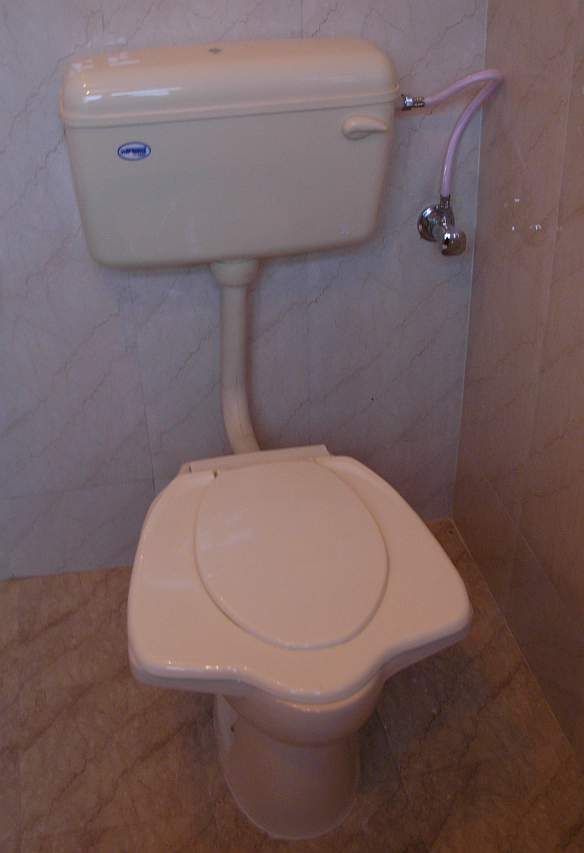
The “Anglo-Indian…”
Meanwhile, work has been continuing on our own bathroom; since we arrived we’ve been using our landlord’s bathroom downstairs. He has the type of toilet we fondly refer to as a “squatty potty.” This type of fixture is familiar to us, but we now find that our aging knees make the squats difficult. When Brad went with our landlord to purchase fixtures for our bathroom, they came home with something we’d never seen before- a hybrid toilet, which they call an “Anglo-Indian.” It looks like an American toilet, but when the seat is lifted up there are footpads for those who like to squat!
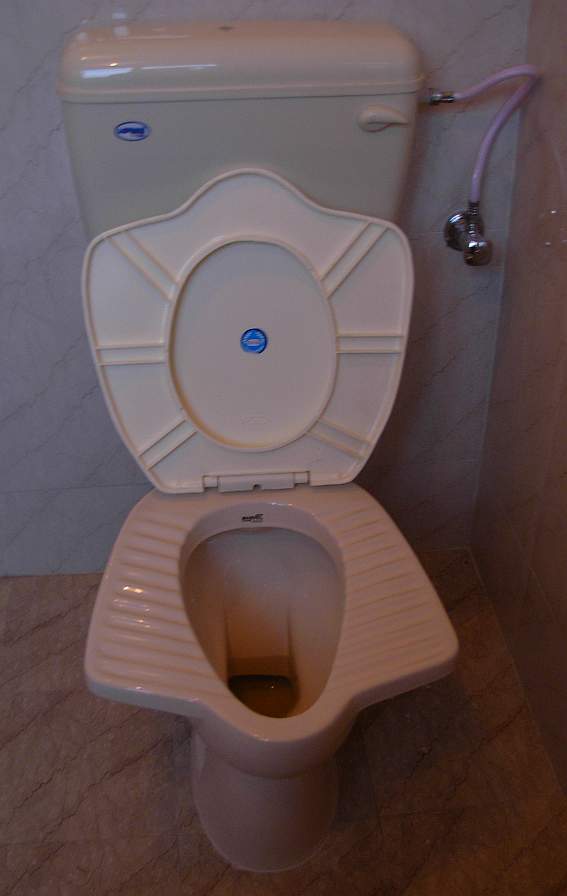
… a hybrid toilet!
So we’ll be able to preserve our knee joints while offering bathroom hospitality to our local guests. The “Anglo-Indian” is one of many examples of creative connection between cultures here and there!
Posted in Uncategorized and tagged hybrid toilet by Lisa
My New Clothes
I finally have my new clothes! On Thursday I picked up my new outfits from the tailor’s shop. (The tailor’s name is Raj and his shop is called “Supersonic Sewing”!) My teammate had taken me to shop for fabric, and helped me pick out pieces that were already embroidered with bright flowers in the local style. Everything was so beautiful that it was hard to choose! Then she took me to Raj’s place and he measured me. I’m guessing he probably hasn’t made women’s pants that long before! But the clothes fit perfectly; he’s really an expert. I feel much better now that I can go out dressed in the local style—baggy pants, long tunic-top, and matching headscarf—rather than my American-style jeans and shirt.
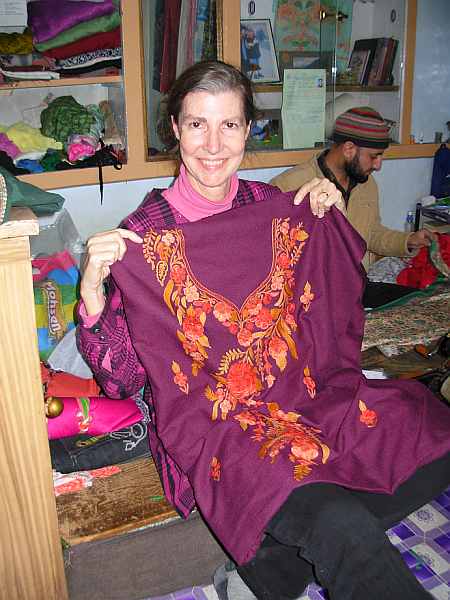
The tailor, sitting cross-legged behind me, works at a sewing machine on a low bench in front of him.
New clothes are only the most visible way in which I am putting on a new identity here in my adopted home. We don’t often think about all those details that make up “who we are,” the person we know ourselves to be and assume others know as well. When I meet someone for the first time, he asks me, “Where are you from?” and I answer, “California,” but that doesn’t begin to describe my globe-trotting background. “What do you do here?” is the second question, to which I answer, “I am learning your language… my husband is an agro-forestry consultant…” and that says almost nothing at all about my past experience, all my training, or what really brings me to this place. Underneath my new clothes, I still have a strong sense of who I am and Whose I am, but as yet my neighbors don’t know me at all. Still, I hope this new plum-colored outfit with the bright embroidery communicates a little more about who I am: I am a person who is not afraid to let go of my American-ness; I am a person who values this culture and wants to fit in; I am a person who loves beauty and finds it right here around me.
Posted in Uncategorized and tagged new clothes by Lisa
So Many Questions
As I write this, the rain has stopped but our view of the mountains is still obscured by clouds. A constant, heavy pounding in the wall reminds me that work has started on plumbing for a bathroom of our own! Sharing the bathroom with our local host family is one of the many contexts for learning in which I have found myself since our arrival a week ago. I wondered: why are plastic bathroom sandals important? So many questions… What is the difference between morning bread and afternoon bread? Which bus will take me to the market, and which one will bring me home again? How do local people stay warm in uninsulated houses in freezing weather? How do I wear my headscarf to keep it from falling off? What about doing laundry? I just learned about laundry this morning. Our host family has a washing machine, but Indian washing machines are nothing like the ones I’m used to, and I needed lots of help (and plastic sandals).
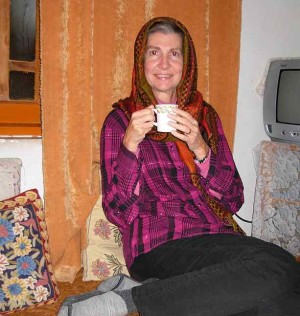
Headscarf and chai
Needing help is an essential component of the experience of adjustment. We are on the bottom end of an extremely long and steep learning curve. Our host family has a two-and-a-half year old son, and this morning after breakfast his older sister was helping him learn to count. As I listened, I realized that this little boy is already ahead of me in his language and cultural abilities! In many ways, I’ve left behind the competent, intelligent, mature person I used to be and become stupid and needy in order to fully enter this culture. It isn’t easy to let go of that former ME and embrace this new childlike one. Beneath all the nitty-gritty of daily life it’s about loving these people from inside their world, rather than just from the outside. We also call this “incarnation.” I’ll need a dose of humility with my morning cup of chai in order to fully embrace the process, keep asking questions, and trust for the answers.
Posted in Uncategorized and tagged questions by Lisa
Love Our Only World
When I had to decide on a title for my blog, I chose the last line of the poem called “Starfish” by Mary Daniels. I can easily call to mind memories of looking into a tidepool, fascinated by the beauty of those colorful animals among the rocks, but reluctant to reach into the unknown, to enter their alien world and touch them. As I cross the bridge into this new adventure in ministry, I have similar feelings. The last part of the poem goes like this:
What good does it do/ to lie all day in the sun/ loving what is easy?
It never grew easy,/but at last I grew peaceful:
all summer/ my fear diminished
as they bloomed through the water/ like flowers, like flecks
of an uncertain dream,
while I lay on the rocks, reaching/ into the darkness, learning
little by little to love/ our only world.
My hope is that writing this blog will help me see more clearly and appreciate the beauty around me as I share it, and extend love’s reach into the darkness, little by little.
Posted in Uncategorized and tagged poem by Lisa